
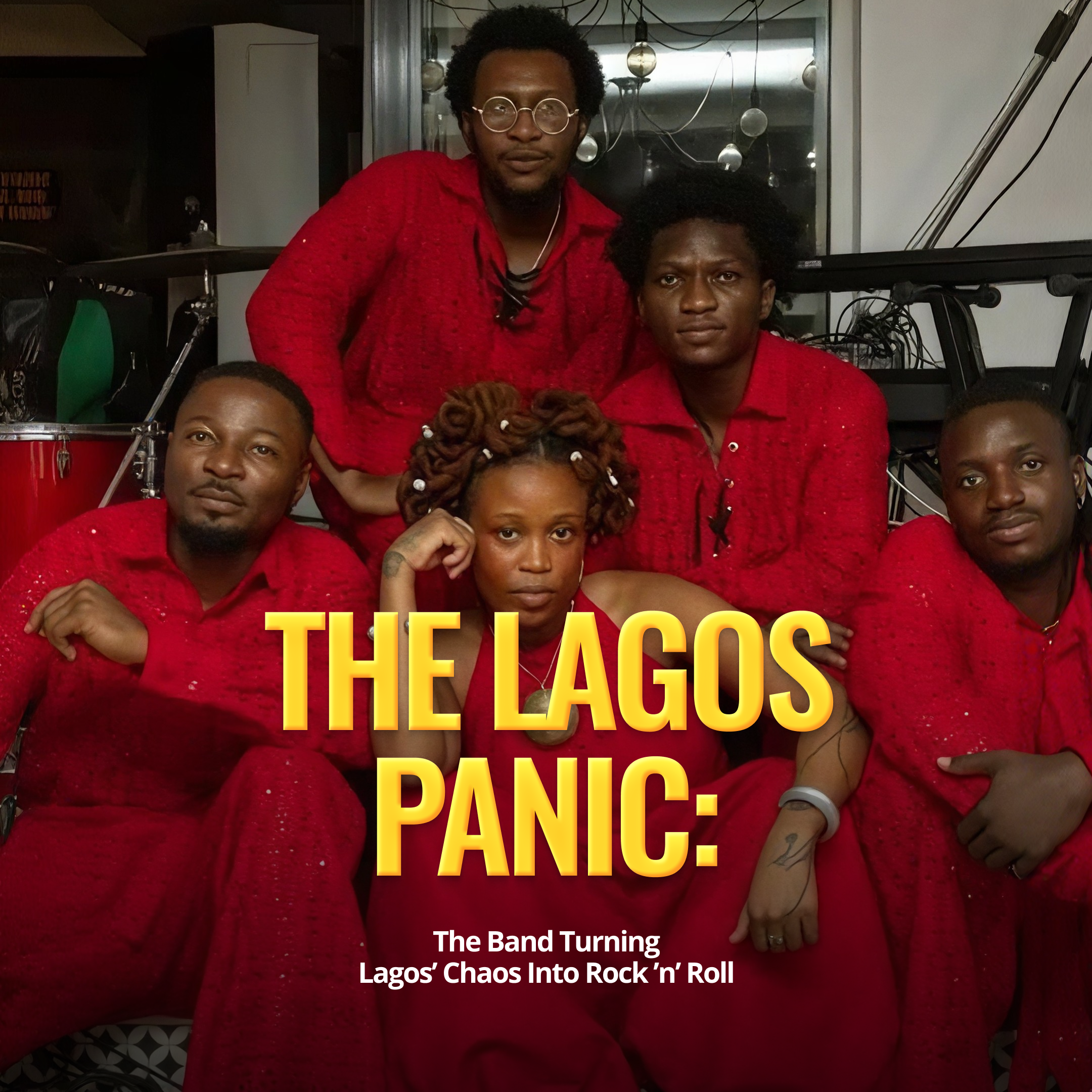
The Lagos Panic: The Band Turning Lagos’ Chaos Into Rock ’n’ Roll
The Lagos Panic: The Band Turning Lagos’ Chaos Into Rock ’n’ Roll
There is something inherently restless about Lagos.
The city moves at an almost impossible speed. Its streets are loud, its nights are unpredictable, and its creative energy rarely stays inside the lines. For The Lagos Panic, that chaos isn’t something to escape. It is the inspiration.
Formed in 2021 by Nigerian alternative artist Lady Donli, The Lagos Panic emerged as a five-piece band with a simple but ambitious idea: to bring the energy of a live band back to the centre of contemporary Nigerian music. Their sound pulls from African rock, psychedelic music, Afrobeat and the traditions of live instrumentation, creating something that feels simultaneously nostalgic and distinctly modern.
The name itself is an appropriate description of their musical world. Lagos can feel like a beautiful contradiction: exhilarating and exhausting, chaotic and inspiring, traditional and constantly reinventing itself. The Lagos Panic embraces all of it.
Born From the Live Show
Before becoming an independent musical identity, The Lagos Panic was closely associated with Lady Donli’s live performances.
The band was introduced publicly in 2021 as Donli’s live band, quickly becoming an important part of her performances. Their early appearances demonstrated that they weren’t simply there to reproduce recorded songs. The chemistry between Donli and the musicians transformed her performances into something much more theatrical and unpredictable.
At the 2021 Alté Culture Festival, for example, Lady Donli and The Lagos Panic delivered a performance that moved from calm and controlled to explosive, perfectly matching Donli’s “Pan African Rockstar” persona.
That emphasis on performance
has remained central to the band’s identity.
In an interview discussing her musical future, Donli described The Lagos Panic as more than simply a backing band. She spoke about wanting the individual musicians to be recognised for their own abilities and expressed her desire for them to eventually compose new music together.
That distinction matters.
The Lagos Panic is not simply about having a band behind an artist. It is about creating a collective.
Finding Their Sound
The band’s music sits somewhere between the familiar and the unexpected.
African musical traditions provide one foundation, while rock, psychedelic sounds and older Western influences provide another. The band’s Spotify profile cites influences ranging from Fela Kuti to The Beatles, while their work with Lady Donli demonstrates how easily they can move between Afrobeat, highlife, rock and alternative sounds.
 One of the earliest major examples of this chemistry came with “Thunderstorm in Surulere,” released in 2022.
The song was produced by BenjiFlow, with additional production and composition by The Lagos Panic. It gave listeners an early opportunity to hear the band’s contribution beyond the stage, adding the fullness of live instrumentation to Lady Donli’s sound.
The song also established something that would become important to the band’s identity: Lagos itself could become part of the music.
Even the title “Thunderstorm in Surulere” evokes a very specific Nigerian experience. It is urban, local and atmospheric, turning an everyday Lagos setting into a musical landscape.
The Pan African Rockstar Connection
The relationship between Lady Donli and The Lagos Panic became even more prominent with her 2023 album, Pan African Rockstar.
The project featured The Lagos Panic on “Comme ci comme ça,” a song that combines elements of highlife, dance and rock. The collaboration demonstrated the band’s ability to exist comfortably outside the boundaries of conventional Afrobeats.
The Native described Lady Donli as an artist
who has continually reinvented her sound,
and The Lagos Panic became an important part of that evolution.
Their contribution also helped reinforce one of the most interesting aspects of Donli’s musical identity: her willingness to treat African music as a broad, constantly evolving ecosystem rather than a single sound.
And The Lagos Panic fits perfectly into that philosophy.
A Band Built for the Stage
If there is one place where The Lagos Panic truly makes sense, it is onstage.
Their early performances with Lady Donli established a reputation for high-energy shows, with the musicians functioning as an essential part of the spectacle rather than simply accompanying the singer.
A 2022 performance in Abuja further demonstrated that chemistry. During Lady Donli’s homecoming concert at Mambaah Cafe, the band performed alongside her in a set that blended musicianship, movement and theatricality.
This focus on live performance also makes The Lagos Panic particularly interesting within Nigeria’s current music landscape.
Afrobeats has become increasingly dominated by studio production, individual stars and digitally driven releases. Bands, by contrast, require a different kind of relationship between musicians and audiences.
They have to communicate in real time.
They have to respond to the room.
And The Lagos Panic appears to understand that instinctively.
Beyond Afrobeats
Perhaps the most interesting thing about The Lagos Panic is what they represent.
Nigeria has a long history of bands and guitar-driven music, from highlife and juju to Afrobeat and the rock movements that followed. Yet contemporary Nigerian popular music is often discussed primarily through individual artists and genres such as Afrobeats, Afropop and Amapiano.
The Lagos Panic offers another possibility.
They are part of a newer generation of Nigerian musicians exploring what happens when traditional African sounds meet rock, psychedelia, alternative music and live instrumentation.
This experimentation is happening against the backdrop of a wider underground rock and alternative scene in Nigeria, where musicians and communities continue to create spaces for guitar-driven and unconventional music despite the dominance of mainstream Afrobeats and gospel.
The Lagos Panic doesn’t necessarily sound like a traditional Nigerian rock band.
And that may be precisely the point.
They are building something that feels Nigerian without being restricted by expectations of what Nigerian music is supposed to sound like.
The Panic Returns
After establishing themselves primarily through live performances and collaborations, The Lagos Panic entered a new chapter in 2026 with the release of “FFG,” their first official single.
Released on July 15, 2026, the song is credited to The Lagos Panic and Lady Donli and was released through Panic Room Africa.
The release is significant because it represents a shift from being known largely as Lady Donli’s live band to stepping forward under their own name.
And the timing feels appropriate.
Five years after their emergence, The Lagos Panic are now entering a music industry that has become even more global, experimental and genre-fluid. Their challenge, and opportunity, is to show audiences exactly what happens when the musicians who once stood behind the star step into the spotlight themselves.
Their return has already attracted international attention, with FFG appearing across African music playlists and platforms.
Why The Lagos Panic Matters
The story of The Lagos Panic is ultimately bigger than one band.
It is about the continued relevance of musicianship in an industry increasingly shaped by digital production. It is about the power of live performance. It is about Nigerian artists refusing to be boxed into a single genre.
Most importantly, it is about Lagos.
The city has always produced music that reflects its contradictions. Fela turned its political frustration into Afrobeat. Highlife musicians transformed everyday experiences into celebration. Contemporary artists continue to turn Lagos’ nightlife, romance, struggle and ambition into sound.
The Lagos Panic simply adds another layer to that story.
Their music carries the urgency of a city that never really stops moving. Their live performances carry the unpredictability of a night out in Lagos. And their eclectic influences reflect a generation of Nigerian creatives who see no reason to choose between African music and global sounds.
The panic, in this case, isn’t something to fear.
It is the sound of Lagos coming alive.

Leave a Reply